

Weekly Resident in Switzerland: Registration, Permit, Taxes and Room

Jens Herbst
CEO BoVita
Read time
9 min
Published
Jul 12, 2026
Quality
Verified
As a weekly resident your centre of life stays at your main residence while you live at your place of work or study during the week. You register a secondary residence there within 14 days and deposit the Heimatausweis. With a main residence in Switzerland you need no new permit, usually pay tax on your income at your main residence and can deduct work-related costs like accommodation, meals and home trips. A furnished all-in room, for example with BoVita in Aarau, Brugg, Wohlen or St. Gallen, is the simplest solution.
«Bei der Miete von möblierten Zimmern und von gesondert vermieteten Einstellplätzen oder ähnlichen Einrichtungen können die Parteien mit einer Frist von zwei Wochen auf Ende einer einmonatigen Mietdauer kündigen.»
Key Takeaways
- 01Weekly resident: centre of life stays at main residence, secondary residence at work or study location
- 02Registration usually within 14 days, deposit the Heimatausweis, often online in AG and SG
- 03With a Swiss main residence no new permit, from abroad usually the G permit
- 04Taxes usually at main residence, deductions for accommodation, meals, travel and home trips
- 05Furnished all-in room at BoVita from CHF 620, in Aarau, Brugg, Wohlen and St. Gallen
Switzerland Registration, Complete Word Kit (Checklist, Documents, 7-Day Plan)
Editable Word kit for registering at the residents' office: document checklist by status, 7-day plan, ready-to-send appointment email template, on-site questions list, cost table, post-appointment checklist, common pitfalls and cantonal contacts (AG, ZH, SG). Works in Word, Pages and Google Docs.
01
Who counts as a weekly resident
You count as a weekly resident (Wochenaufenthalter) when your centre of life stays at your main residence, but during the week you work or study somewhere else and therefore rent a room or a small apartment there. On your days off or at the weekend you regularly return to your main residence.
Typical weekly residents are commuters with a long journey to work, specialists on a fixed-term project, professionals with family in another canton, and students, for example at the FHNW in Brugg and Windisch or at the University of St. Gallen.
Weekly resident, change of residence or cross-border commuter: what is the difference?
- Weekly resident: Your main residence and centre of life stay put; at your place of work or study you register a secondary residence.
- Change of residence: You move your centre of life entirely and deregister your previous residence.
- Cross-border commuter: You live abroad and commute into Switzerland for work.
The difference matters, because it determines your registration, permit and taxes. We go through those three topics in order, and then how to find the right room.
02
Registration step by step (14 days)
Anyone who is likely to stay regularly at a second location for more than three months in a calendar year counts as a weekly resident and must register there. The deadline is short: as a rule you have 14 days from moving in to register with the residents' office at your weekly-residence location. If you register late, some municipalities can issue a fine.
Here is how registration as a weekly resident works, step by step:
1. Order the home certificate (Heimatausweis) from your home municipality
Your main-residence municipality issues the Heimatausweis. It confirms that you are still registered there and is deposited at your weekly-residence location.
2. Rent a room or apartment
You need a rental or sublease contract, a housing confirmation from the landlord or proof of ownership. Without proof of accommodation, registration is not possible.
3. Register within 14 days at your weekly-residence location
Register a secondary residence with the residents' office and deposit the Heimatausweis. In many municipalities this can now be done conveniently online.
4. Bring the right documents
Commonly required: Heimatausweis, rental contract, employment contract or proof of enrolment and a valid ID. Employed persons sometimes have to briefly state why they claim weekly residence.
5. Renew every year
The Heimatausweis is usually valid for about one year. When it expires, you need to renew and deposit it again.
The exact process and costs depend on the canton and municipality. Let's look directly at the two cantons relevant for BoVita, Aargau and St. Gallen.

03
Registration in detail: Aargau and St. Gallen
BoVita rents furnished rooms in Aarau, Brugg and Wohlen in the canton of Aargau, as well as in St. Gallen. So here's how registration works specifically for these two cantons. The binding information always comes from your home and your host municipality.
Canton of Aargau, for Aarau, Brugg and Wohlen
In Aargau you register within 14 days with the residents' services of your host municipality and deposit the Heimatausweis. In many places, registration and deregistration are possible online via the cantonal eUmzug service. The Heimatausweis is valid for about one year and must be renewed after that.
City of St. Gallen
The city of St. Gallen also applies the 14-day deadline. Registering late risks a fine of up to 200 francs. Students, for example at the University of St. Gallen, a university of teacher education or a university of applied sciences, and employed persons with a main residence in Switzerland can register a secondary residence online around the clock. Required documents include a rental contract, employment contract or proof of enrolment, and the Heimatausweis. Employed persons must also briefly state why they claim weekly residence. Registration is subject to a fee.
| Point | Canton of Aargau | City of St. Gallen | |
|---|---|---|---|
| Deadline | 14 days from move-in | 14 days from move-in | |
| Late registration | fine possible, depends on municipality | fine up to 200 francs | |
| Online possible | yes, via eUmzug | yes, with a main residence in Switzerland | |
| Heimatausweis | deposit, valid approx. 1 year | deposit | |
| Note | process varies by municipality | employed persons: short justification needed |
Important: details, fees and responsibilities can differ from municipality to municipality. Always check the exact process with the local residents' office.
Get started now
Switzerland Registration, Complete Word Kit (Checklist, Documents, 7-Day Plan)
Editable Word kit for registering at the residents' office: document checklist by status, 7-day plan, ready-to-send appointment email template, on-site questions list, cost table, post-appointment checklist, common pitfalls and cantonal contacts (AG, ZH, SG). Works in Word, Pages and Google Docs.
04
Which permit you need
Which permit you need depends on where your main residence is and on your nationality.
- Main residence in another Swiss canton: At your place of work you only register a secondary residence and need no new permit. This applies to Swiss citizens as well as to foreign nationals who already hold a valid residence permit.
- Main residence abroad, work in Switzerland: You need a permit for gainful employment. Those who only stay in Switzerland during the week and regularly return abroad often receive the G permit, the same permit as cross-border commuters. Whether G, B or L fits is decided by the cantonal migration authority.
- Nationals of third countries: Stricter rules apply here. Again, the cantonal migration authority is decisive.
For most weekly residents who rent a BoVita room, the first case applies: main residence in Switzerland, secondary residence at the place of work or study, no additional permit needed.
05
Taxes as a weekly resident
As a rule you pay taxes at your place of residence, that is, where your centre of life is. For weekly residents with a main residence in Switzerland, this usually means: your income is taxed at your main residence, not at your place of work.
The crux for single people
For single people, the Federal Supreme Court assumes that your centre of life is at your place of work, that is, where you sleep during the week. You can rebut this assumption by showing that you regularly travel home at weekends and have close ties there, such as family, a partner, friends or clubs. For married people and families, the centre of life is almost always at the family home.
What you can deduct as a weekly resident
If you live away from home for work reasons, you can claim the additional costs in your tax return:
| Deduction | What it means | |
|---|---|---|
| Accommodation | rent for the room at your place of work | |
| Meals away from home | extra meal costs, usually as a flat rate | |
| Travel costs | commute at your weekly-residence location | |
| Weekend home trips | regular trips to your main residence |
The exact amount of the deductions, the flat rates and the recognition as a weekly resident are governed cantonally and depend on your situation. This is not tax advice. Clarify your case with the cantonal tax administration or a professional before relying on it.
06
Finding the right room
As a weekly resident, a different set of things matters for the room than for a classic move. You do not want to carry furniture, you just want to arrive, live and work during the week. Here is what to look for:
- Furnished and predictable: bed, desk and wardrobe are there; utilities and Wi-Fi are ideally included in the price. That way you know your fixed costs and barely have to organise anything. What you handle yourself is usually just your own room electricity and the Serafe fee.
- Good public-transport access: as a weekly resident you commute daily to work or university. A room near the station or a stop saves you time every day.
- Fair, predictable term: projects and semesters end. Look for a fair notice period and a clear contract term.
- Written contract and inventory: everything important belongs in the contract in black and white, including exactly what is included in the price.
Short notice period for furnished rooms
The law provides a short notice period for furnished rooms. The contract can extend it, but not shorten it. This gives you flexibility if your assignment ends earlier than planned. You'll find the exact wording in the highlighted box further up on this page.
Quick checklist before you commit
- Clear, current photos and a viewing, in person or by video call
- Rent, utilities and deposit shown transparently and separately
- Written rental contract with notice period, term and inventory list
- Never pay in advance without verified identity and a contract
With a clean rental dossier you are faster than other applicants. Our rental application service shows you what a strong dossier looks like.
07
What it really costs
What a room costs as a weekly resident depends on region, size and amenities. What matters is comparing total costs, not just the net rent. A furnished room with everything included looks more expensive at first glance, but it saves you furniture, utilities, internet and cleaning.
| Item | Own apartment, net rent | Furnished room, all-in | |
|---|---|---|---|
| Rent | from approx. 900 francs | from approx. 620 francs | |
| Furniture, spread out | applies | included | |
| Water, heating, shared electricity | extra | included | |
| Internet and Wi-Fi | extra | usually included | |
| Effort | contracts, move, deregistration | move in and live |
On top of that comes the tax advantage: as a weekly resident you can often deduct the cost of the room at your place of work and the weekend home trips from your taxes. That noticeably lowers your effective net cost. So do not just count the rent. Count the cost after deductions.
At BoVita, furnished rooms start from CHF 620 per month depending on location and size, all-in and with no hidden costs. What you also handle yourself is the room electricity and the Serafe fee, more on that right away.
08
Serafe and electricity, sorted smartly
Two cost items no landlord covers for you, not even BoVita: the Serafe broadcasting fee and the electricity you use in your own room. In a shared flat this often causes friction. Here is how to settle both cleanly and fairly.
Serafe: as a weekly resident you pay only once. The Serafe fee (CHF 335 per year) is charged per household, not per person. You already pay it at your main residence. At your secondary residence, that is your shared flat during the week, you do not have to contribute again, because the fee applies per apartment and you already pay it at home. Put it in writing in your flatshare agreement that weekly residents with a main residence elsewhere are exempt from the Serafe share. That settles the most common flatshare dispute. Exception: anyone who stays there more than 26 weeks per year with three or more nights per week, while the main household at that address is also occupied, counts as a separate household.
Room electricity: sub-meter or a fair flat rate. The general electricity for heating, hot water and shared areas is part of the utilities. What you use in your own room, laptop, light and devices, is each tenant's own responsibility. The fairest option is a calibrated sub-meter per room, so everyone pays exactly what they use. Alternatively a flat rate that is named clearly in the contract. Important, according to the Federal Supreme Court: the landlord may not profit from utilities, only pass on the actual costs. Clarify before you move in how room electricity is billed, and get it in writing.
At BoVita, both are stated transparently in the rental contract. From day one you know what is included in the rent and what is not.
09
Living as a weekly resident with BoVita
BoVita is built for exactly this situation: furnished rooms with everything included, at four locations in German-speaking Switzerland, easy to reach by public transport and with fair, clear terms.
- Four locations: Aarau, Brugg, Wohlen and St. Gallen, close to workplaces, universities and stations.
- Fair all-in rent: furniture, utilities and Wi-Fi in one transparent monthly rent, with no hidden costs. The only things you handle yourself are the electricity in your own room and the Serafe fee, both stated clearly in the contract.
- Flexible and predictable: clear contracts and fair notice periods, suited to projects and semesters.
- Not on site yet or abroad? On request you view the room live by video call, ideal when you live elsewhere during the week.
Reserve a slot with no fuss or ask about a room. You will have a clean rental dossier ready in a few minutes.
Ready for your new home in Aarau?
Furnished shared rooms from CHF 620/month, flexible deposit options, quickly available.
Switzerland Registration, Complete Word Kit (Checklist, Documents, 7-Day Plan)
Editable Word kit for registering at the residents' office: document checklist by status, 7-day plan, ready-to-send appointment email template, on-site questions list, cost table, post-appointment checklist, common pitfalls and cantonal contacts (AG, ZH, SG). Works in Word, Pages and Google Docs.
Frequently Asked Questions
8 questions answered
You count as a weekly resident when your centre of life stays at your main residence, but you are likely to stay regularly at a second location for work or study for more than three months in a calendar year. At the weekend you regularly return home.
Sources & Methodology
7 verified sources
- 01
- 02
- 03
- 04
- 05Federal Tax Administration (FTA)estv.admin.ch
- 06SEM, working in Switzerland, permitssem.admin.ch
- 07
About the author: Jens Herbst
Founder and Managing Director, BoVita
Jens Herbst came to Switzerland as a young professional himself and knows first hand how hard affordable housing is to find. That is exactly why he founded BoVita. Today BoVita operates furnished housing at four locations and runs its own property management for rooms, flatshares and co-living. What you read in these articles comes from day to day operations, not from second hand sources.
Related Articles
You might also like

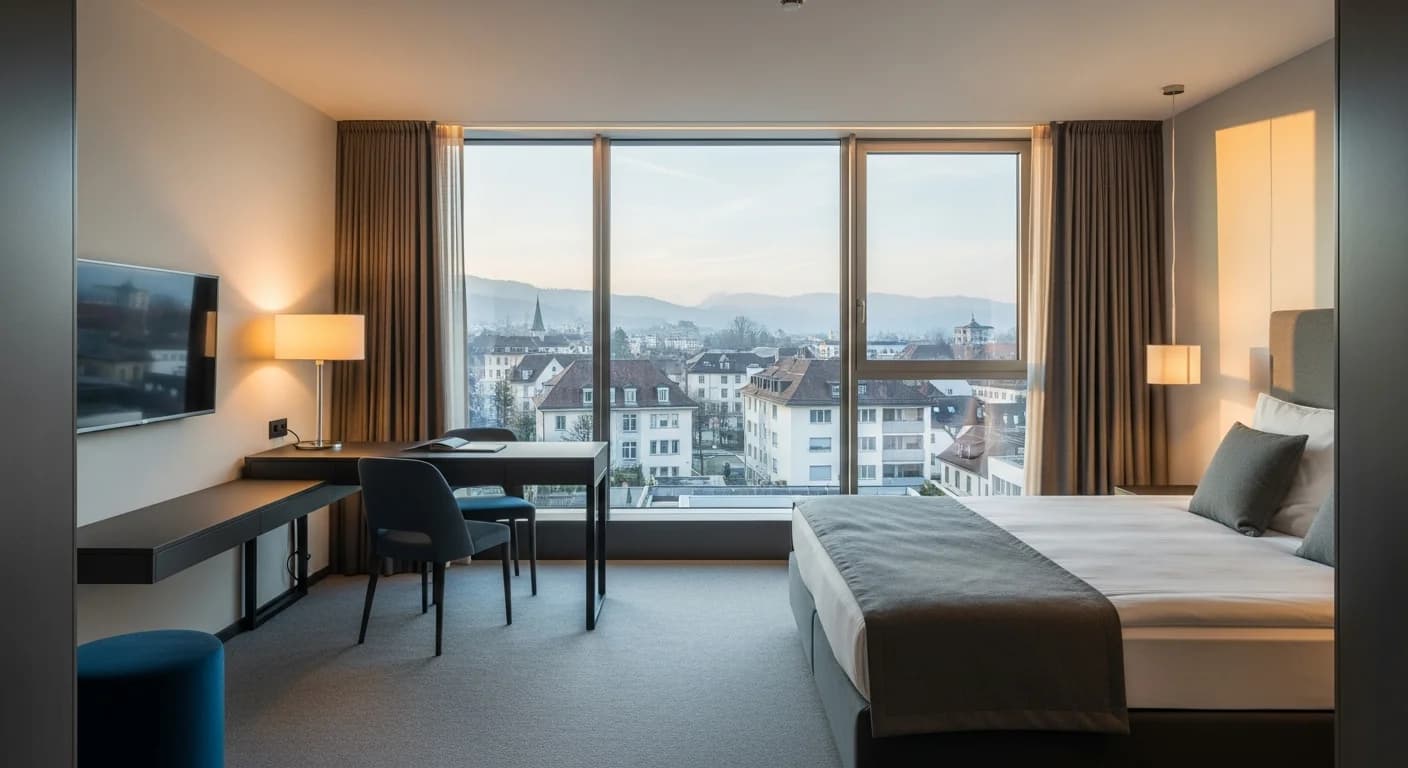
Available furnished rooms in Aarau
Central location in Aeschbach quarter, right by the train station and cantonal hospital. Perfect for professionals and students.
Other locations: