
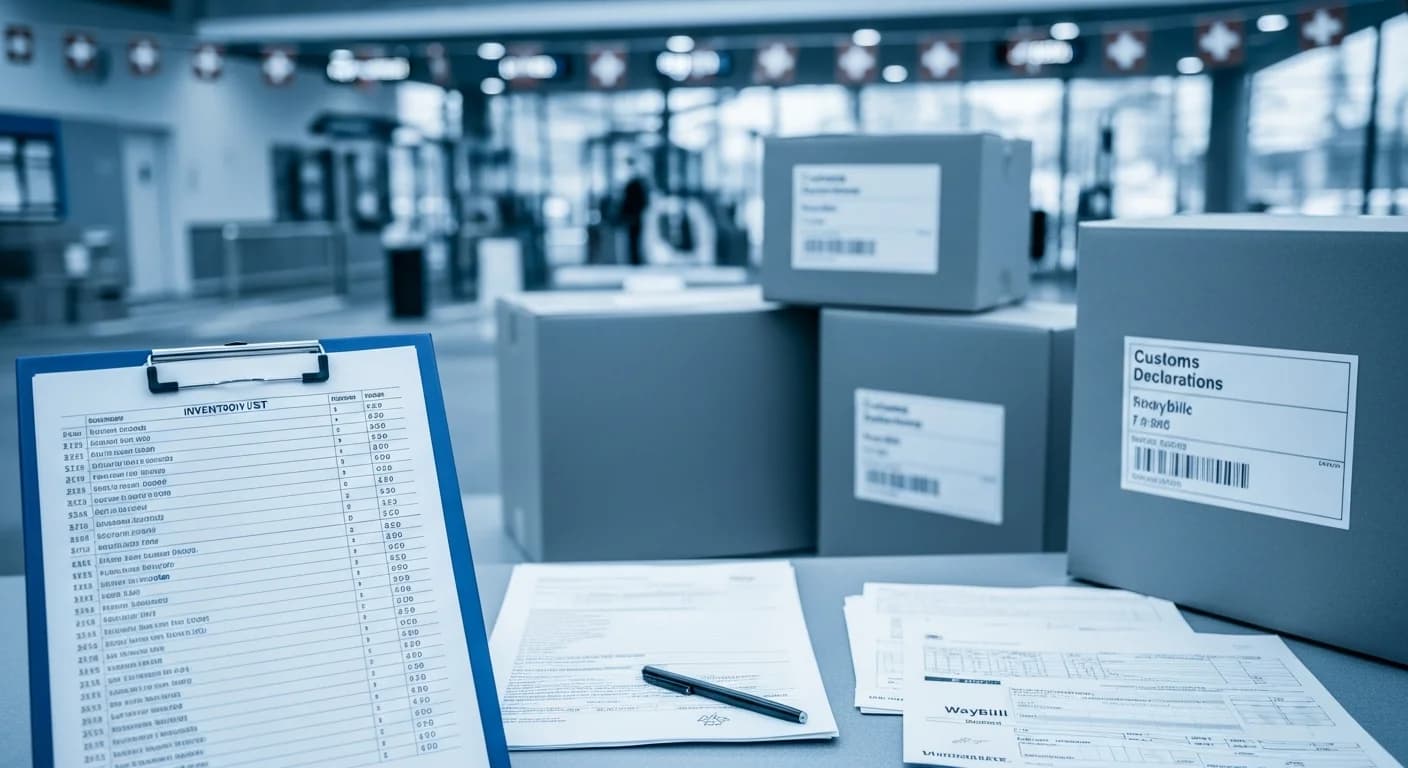
Swiss customs when moving, form 18.44 and inventory list, how to get it done without stress

Jens Herbst
CEO BoVita
Read time
10 min
Published
Feb 4, 2026
Updated
Aug 2, 2026
Quality
Verified
To import your household effects duty free, you must transfer residence to Switzerland, usually have used the items for at least 6 months and keep using them. You fill in form 18.44 yourself, sign it and present it together with an inventory list. Key for planning: no advance notification is needed, but household effects are generally cleared only Monday to Friday during the opening hours of the customs office responsible for commercial goods, at some large offices also on Saturday morning. Use the truck lane on entry and declare follow up shipments on a separate list already at the first import.
Key Takeaways
- 01Customs clearance runs Monday to Friday during the opening hours of the commercial goods office, at some large offices also on Saturday morning. Plan your moving day around it
- 02No advance notification is needed, you report directly on entry. Use the lane for commercial goods, the truck lane
- 03Form 18.44 plus an inventory list are required, you fill in and sign both yourself
- 04Duty free import requires real relocation and usually at least 6 months of prior use
- 05In the inventory list the current value counts, not the price when new. You may estimate weight and value
- 06Declare follow up shipments on a separate list at the first import, otherwise it gets complicated
- 07New items, high value pieces and vehicles are special cases you should plan separately
Customs Form 18.44 + Inventory List Pack
Editable Word pack for moving to Switzerland duty-free: timeline for form 18.44, a filled-in sample list plus a ready-made inventory template, document checklist and an optional letter to the customs office.
01
The 2 Minute Quick Check, Can You Import Duty Free
Before diving into details, answer these questions:
1. Are you moving your residence permanently to Switzerland?
If yes, you can import household effects duty free. If no, other rules apply.
2. Have you used the items for at least 6 months?
This is the usual condition for household effects. New items or barely used things may be treated differently.
3. Will you continue to use the items in Switzerland?
Household effects must not be intended for sale.
4. Will you reach the border on a working day during opening hours?
This is the question people overlook most often. Customs clearance of household effects is generally only possible from Monday to Friday during the opening hours of the customs offices responsible for commercial goods, at some large offices also on Saturday morning. If you book the moving van for a Sunday because it is cheaper, you will find the office closed.
If you answer yes to all four, the basic requirement is met. Then it is time for the documents.
Our inventory list generator checks the same four points with you first, residence transfer, length of use, continued use and your move date, before it builds the list with you. Free, no account.
02
Household Effects Requirements, What Actually Matters
Residence transfer
You must prove that you are transferring your residence to Switzerland. This is usually done through registration with the municipality and the corresponding residence permit.
Minimum usage period
Items should generally have been in your possession and use for at least six months. This is not equally strict for everything, but the newer something is, the more you may need to explain why it still qualifies as household effects.
Continued use
You may not sell the items directly after import. They are for personal use.
No commercial purpose
Household effects are private. If you import goods for a business, different rules apply.
If you are unsure whether your situation qualifies as household effects, contact the relevant customs office in advance. That saves stress on the day of crossing.
03
Form 18.44, How to Fill It Out Without Mistakes
Form 18.44 is the official document for duty free import of household effects. The sheet itself is headed «Antrag/Zollanmeldung für Übersiedlungsgut (Umzugsgut)», and the form carries its own English rendering right underneath: «Application/customs declaration for clearance of household effects». That is the wording to look for, the sheet is bilingual. You can get it from the FOCBS (Federal Office for Customs and Border Security) or online.
How to fill it out:
- Personal details: Name, date of birth, previous address, new address in Switzerland.
- Entry date: When you enter or entered Switzerland.
- Description of goods: Here you refer to the attached inventory list.
- Declaration: You confirm that these are household effects and conditions are met.
Tips:
- You fill in the form yourself and you sign it yourself. Nobody does that for you.
- Fill it out neatly and completely, incomplete entries cost you time at the customs office.
- Take multiple copies in case you pass through different customs points.
Do you have to notify customs in advance?
No. You can report directly when you enter, no advance notification at the customs office is required. What you need to plan is not an appointment but a time window: the office has to be open.
The form alone is not enough. You also need an inventory list.
Get started now
Customs Form 18.44 + Inventory List Pack
Editable Word pack for moving to Switzerland duty-free: timeline for form 18.44, a filled-in sample list plus a ready-made inventory template, document checklist and an optional letter to the customs office.
04
Inventory List, The Format That Works at Customs
The inventory list is a record of all items you are importing. It does not need to list every spoon, but it must be plausible.
How to do it right:
- Organize by category: Furniture, electronics, clothing, books, kitchen items, personal belongings.
- Give quantities: e.g. 5 boxes of books, 2 suitcases of clothes, 1 sofa.
- List valuable items separately: Laptop, camera, jewelry with approximate value.
- Enter the current value, not the price when new. A sofa you bought ten years ago for CHF 1200 is not worth CHF 1200 today.
Four lines to read, and the part of your move that really costs time: typing every item, sorting it, estimating current values, and arranging the result so the customs office can work with it. That is exactly the work our generator takes off your hands.
You click your household together room by room, small items are bundled into boxes automatically, furniture and valuables get their own line with a current value, and at the end you download the finished list as Word and PDF. No account, no forced email. If you prefer to work offline, take the Word pack on this page instead: blank template, filled-in sample list, document checklist, and the official form 18.44 as a PDF attached to the email.
Example:
| Category | Description | Quantity | |
|---|---|---|---|
| Furniture | Desk, bed, shelf | 3 | |
| Electronics | Laptop, TV | 2 | |
| Clothing | Boxes | 5 | |
| Books | Boxes | 4 | |
| Kitchen items | Boxes | 2 |
Important:
- You do not have to be accurate to the franc. Weight and value may be estimated, and the insured value of your household contents gives you a usable reference point.
- Be realistic. A list that estimates everything at CHF 500 when you have a full household looks implausible.
- New items and gifts that do not meet the 6 months still belong on the list: at the end or on a separate sheet, headed «goods for normal customs clearance» (goods to be cleared through customs) and with the value stated. Leaving them out costs more than declaring them. The first wording is the one printed on official form 18.44, paragraph 2a, and that is the one to write on your sheet. The plain name in brackets is ours, and the FOCBS FAQ 6 calls the very same section «Goods to be taxed». They all mean the same list.
05
Follow Up Shipments, Where Many People Mess Up
Not everything comes with the first move. Maybe you send books later or receive furniture from your old home.
The problem:
If you do not declare follow up shipments at the first import, they are treated as regular imports later. That can mean customs duties and taxes.
The solution:
You must declare later shipments to the customs office on a separate list already at the first import. Not as a footnote on the inventory list, but as its own schedule alongside form 18.44. The customs office takes it on record, and you have fewer problems later.
How long does this apply?
The two years run from your change of residence, not from the first import. Within that period the timing is unproblematic, and the 6 months of use before the move still have to be met. For later shipments customs grants the exemption only under certain conditions, which is why declaring them at the first import matters so much.
Tip:
Make a list of all items that might still come. Better to declare too much once than to pay later.
06
Special Cases, New Items, High Value Pieces, Pets, Vehicles
New items
Unused items are not household effects. If you bring a new device that you have never used, customs may apply. Clarify this in advance.
High value items
Jewelry, artwork or expensive electronics should be declared separately. Bring proof: receipts, photos, valuations.
Pets
Animals have their own rules: vaccination records, chip, possibly quarantine. This is a separate topic, but prepare it in parallel.
Vehicles
Cars and motorcycles are special cases. You need additional documents: vehicle papers, proof of use, possibly type approval. Plan this separately and expect formalities.
Alcohol and tobacco
For larger quantities, allowances apply. Above that, customs is due.
For all special cases: clarify them in advance. Having to explain at customs under time pressure why your new device is still household effects is no fun.
07
Timeline, 14 Days Before Moving Until 7 Days After Arrival
14 days before moving:
- Download and prepare form 18.44
- Create the inventory list, with the generator online instead of by hand
- Clarify special cases (new items, vehicles, pets)
- List follow up shipments on a separate schedule
- Pick the customs office and check its opening hours
The point where most moves go wrong: the time window
Customs clearance of household effects is generally only possible from Monday to Friday during the opening hours of the customs offices responsible for commercial goods, at some large offices also on Saturday morning. The cheap Sunday van is not a saving, it is a lost day. Put the border crossing on a working day in the morning, then you have a buffer if the customs office takes longer.
You do not need an advance notification for this. You report directly when you enter, there is no appointment to book beforehand.
3 days before moving:
- Check documents again
- Make copies
- Pack everything within reach
Moving day / border crossing:
- Use the lane for importing commercial goods, the truck lane. The travellers lane is the wrong one, even with a small van
- Present form and inventory list
- Answer questions calmly and factually
- Declare follow up shipments with the separate list
7 days after arrival:
- Register with the municipality
- Organize proof of insurance
- Keep track of follow up shipments
With this planning, customs clearance usually goes smoothly.
08
Local Notes for Aarau, Wohlen and St. Gallen After Customs
Aarau
After customs, head to the municipality. In Aarau registration is straightforward, you need ID, rental contract and residence permit. Customs clearance itself happens at the border or the nearest customs office.
At BoVita in Aarau, rooms are furnished and ready to move in. You do not need to organize furniture first.
Wohlen
Wohlen is conveniently located. If you enter by car, you will likely use one of the larger border crossings. The municipality of Wohlen is used to new arrivals and processes registrations quickly.
St. Gallen
St. Gallen is close to the Austrian border. The crossing there sees many relocators. The city itself has good infrastructure for newcomers.
At BoVita in St. Gallen we are happy to help you take the next step after customs.
Ready for your new home in Aarau?
Furnished shared rooms from CHF 620/month, flexible deposit options, quickly available.
Customs Form 18.44 + Inventory List Pack
Editable Word pack for moving to Switzerland duty-free: timeline for form 18.44, a filled-in sample list plus a ready-made inventory template, document checklist and an optional letter to the customs office.
Frequently Asked Questions
9 questions answered
Usually not. Customs clearance of household effects is generally only possible Monday to Friday during the opening hours of the customs offices responsible for commercial goods, at some large offices also on Saturday morning. If you arrive on a Sunday or late at night, you will find the office closed. Put your moving day on a working day and check the opening hours of your customs office in advance.
Sources & Methodology
5 verified sources
- 01FOCBS, moving and household effectsbazg.admin.ch
- 02FOCBS, FAQ household effects (German)bazg.admin.ch
- 03SEM, Free Movement of Persons CH-EU/EFTAsem.admin.ch
- 04
- 05
About the author: Jens Herbst
Founder and Managing Director, BoVita
Jens Herbst came to Switzerland as a young professional himself and knows first hand how hard affordable housing is to find. That is exactly why he founded BoVita. Today BoVita operates furnished housing at four locations and runs its own property management for rooms, flatshares and co-living. What you read in these articles comes from day to day operations, not from second hand sources.
Related Articles
You might also like

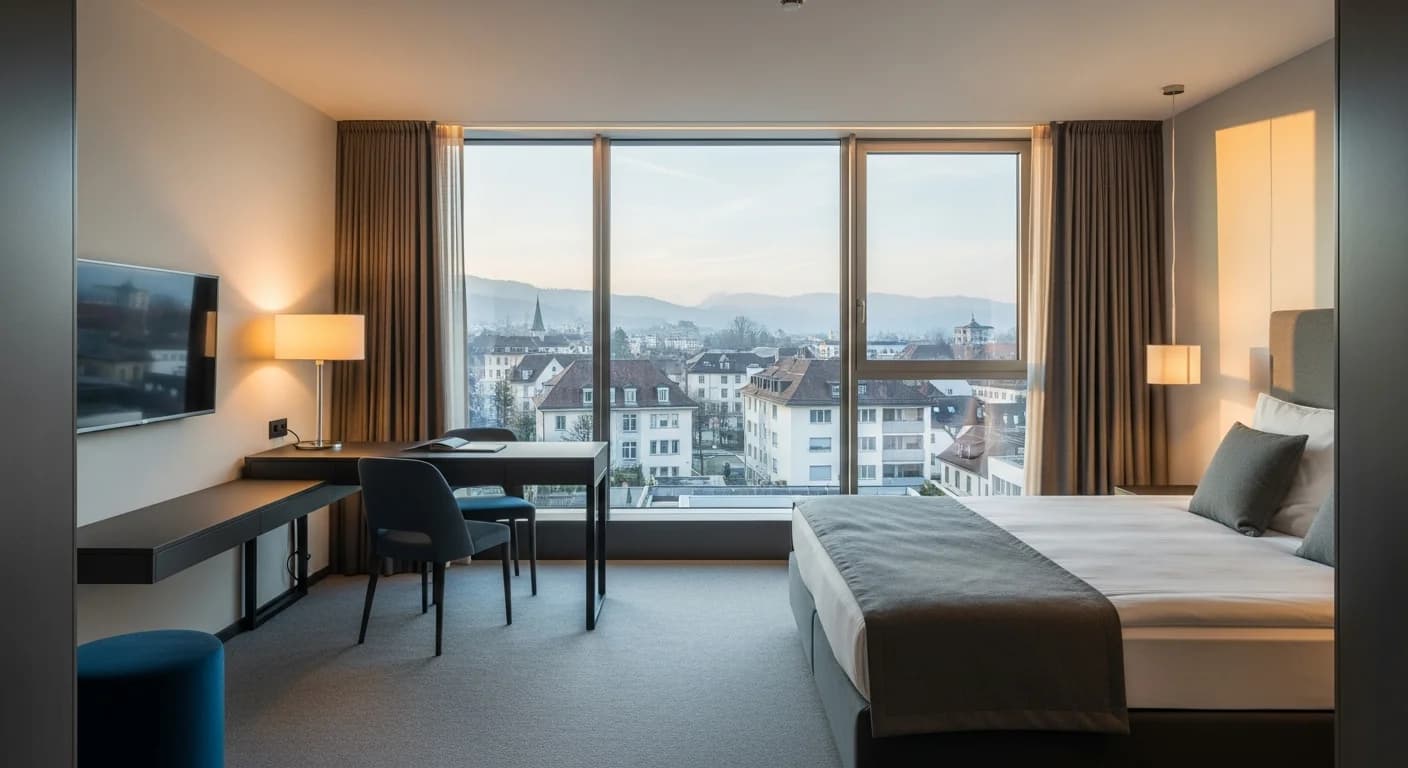
Available furnished rooms in Aarau
Central location in Aeschbach quarter, right by the train station and cantonal hospital. Perfect for professionals and students.
Other locations: